



Space Developments
C3S also participated in several projects that resulted in the expansion of our product portfolio or in the further development of our already existing products, hence increasing quality and quantity.
Research and Development of a Market-Oriented Small Satellite Solar Power System for Space Industry Applications
Current solar panel solutions in the space domain are primarily designed for large satellite missions and are hardly suitable for small satellites considering the optimal energy and thermal balances, so as characteristic heat conduction and radiation properties. The project aims to develop a scalable and resilient solar power system for small satellites operating in low Earth orbit (LEO).
The products of different sizes (3U-16U) to be developed seek to provide a reliable and cost efficient solar power solution for the CubeSat industry, considering the smallsat’s specific mechanical and thermal design requirements. Targeted scalability and enhanced reliability of the product will contribute to the reduction of failed missions and thus mitigation of space debris generation.
EPS 2000
EPS product development
Power. Performance. Beyond the cubesat.
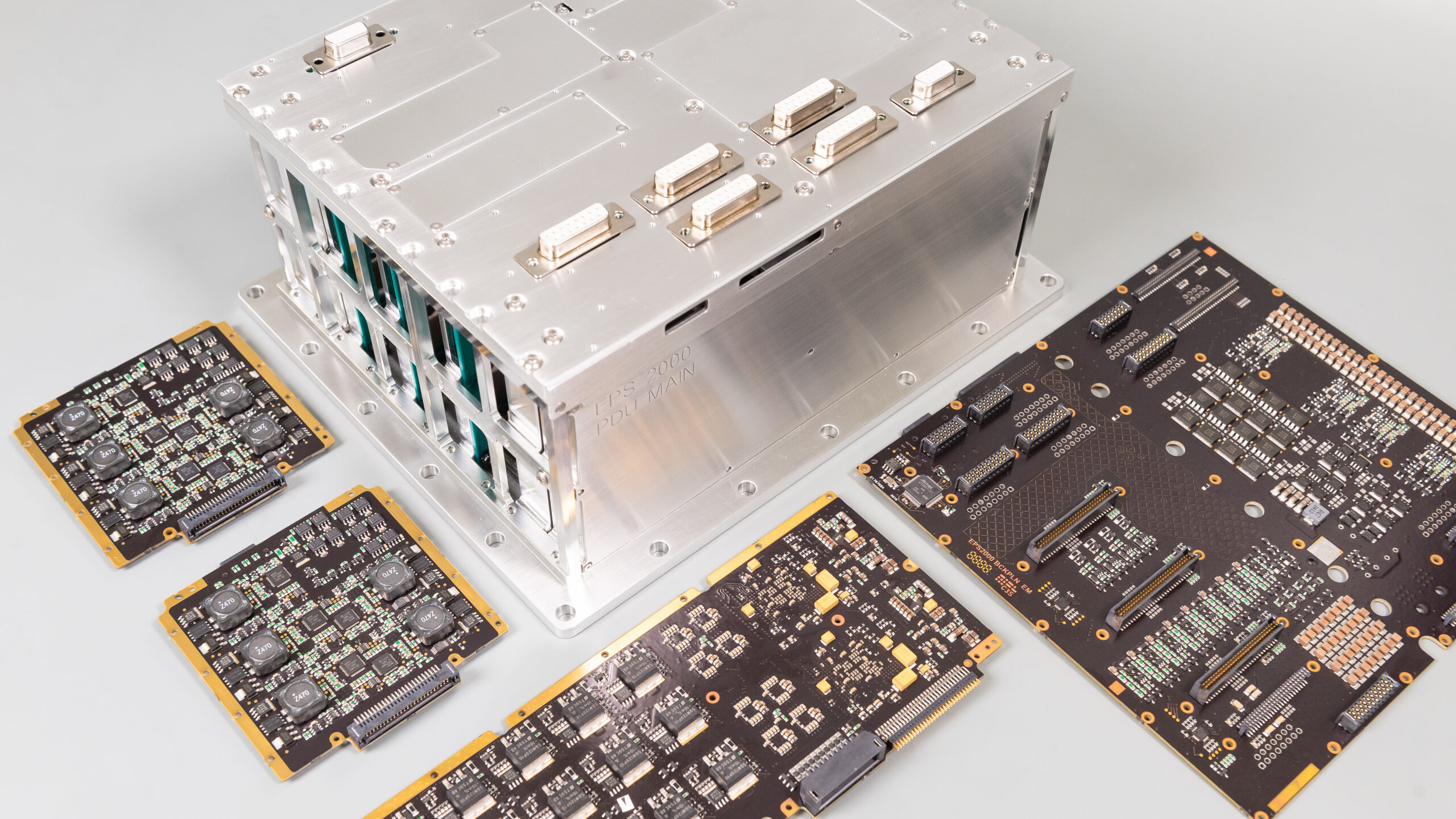
EPS 2000 is C3S’s scalable power supply architecture developed for higher-performance small satellite missions. Designed to support platforms from 12U CubeSats to SmallSats weighing several hundred kilograms, it provides a flexible and cost-effective power backbone for missions with increasing energy demand and system complexity.
Built on C3S’s flight heritage and in-house engineering expertise, EPS 2000 combines high-efficiency power conversion, protected power distribution and fault-tolerant operation. Its modular architecture supports reliable energy management in demanding space environments, while reflecting C3S’s evolution beyond traditional CubeSat platforms toward larger, more capable SmallSat missions.
Key technical parameters:
- redundant architecture
- single point failure tolerance
- graceful degradation capability
The project is being carried out with funding from the European Space Agency under ESA Contract No. 4000145618/24/NL/MH/mp.
The project will be completed in 2027.
MINAS
Modular Interconnected liNear Array Structure
MINAS is an innovative, versatile system currently under development, designed to enable precise linear deployment and operation of four to eight forward- and rear-facing small payloads.
At its core, MINAS features a maximum 3.5 m length, deployable boom that structurally supports and interconnects the payloads throughout their entire operational lifecycle. Each payload is mounted onto a purpose-built interface device — the Glissor — which locks securely onto the boom upon deployment, ensuring payload stability and alignment across the linear array.
MINAS also incorporates an intelligence system, the Data Processing Unit (DPU), which manages the diverse, distributed payloads along the boom to deliver synchronized, coordinated performance. The DPU architecture comprises two hardware components:
- IPC (Intelligent Payload Controller) — located at the base of the boom, responsible for powering, controlling, and commanding the DPU-Nodes.
- DPU-Nodes — located on each Glissor, each controlling up to two individual small payloads.
All DPU-Nodes are connected to the IPC via a bus topology, enabling centralized command and control across the distributed payload chain.
The MINAS project is currently at TRL3 and is expected to reach TRL7 by 2027.
MINAS is being carried out with funding from the European Space Agency under ESA Contract No. 4000152154/26/NL/FM/mmk.
The project will be completed in 2027.
CHAMELEON
COMPACT POWER CONTROL MODULE WITH DIGITAL CONTROL
Compact, Highly Adaptive, Multiphase Electrics for Larger Energy Optimization Needs
C3S participated in the development of a compact Power Conversion Unit (PCU), specialized for telecommunication satellites, that integrates Solar Array Regulation (SAR), Battery Discharge Regulation (BDR), and Battery Charge Regulation (BCR) into a single GaN-based system with FPGA-driven predictive control, reducing mass and volume. Originally designed for telecommunication satellites, it delivers a regulated 28 V bus with 500 W per card. Its modular design scales from 4 to 16 cards, offering redundant operation with defined hierarchical roles (Sheriff, Deputy, Cowboys). As part of the project, C3S developed an Engineering Model (EM) using COTS components, designed for easy future upgrade to space-grade parts.
The CHAMELEON project is being carried out with funding from the European Space Agency under ESA Contract No. 4000142060/23/UK/ND.
The project will be completed in 2027.
HBSE
CubeSat sized hardware-based secure element (HBSE) and service development
The project aims to provide CubeSat missions with a Hardware-Based Security Element (HBSE) that enables secure communication between the space and ground segments. The solution protects data transmissions and command execution through hardware-based cryptographic protection and platform-level encryption, ensuring data authenticity, integrity, and confidentiality.
By providing secure cryptographic key generation and storage within the hardware security element, the solution establishes a trusted and scalable foundation for the next generation of secure CubeSat missions. The HBSE project is being carried out with funding from the European Space Agency under ESA Contract No. 4000136980/21/NL/CBi.
The project will be completed in 2027.
ENCORE
Endlessly Controllable Organically Redundant Inverter
ENCORE is a hot-redundant, single-failure-tolerant PMSM motor-driver architecture under development for time-critical space robotic and mechanism applications. Instead of duplicating the complete motor-drive chain, it combines a phase-redundant GaN inverter, a galvanically isolated GaN power architecture, redundant FPGA-based control electronics, and observer-assisted fault detection and sensor arbitration.
The system is designed to maintain the controlled function following a credible single electronics or sensor fault and to rapidly recover nominal performance. Current simulation results indicate fault detection and recovery within 10 ms for the analysed fault cases. Target applications include robotic-arm joints and end effectors, rover drive and steering actuators, and other high-availability space mechanisms. The ENCORE project is being carried out with funding from the European Space Agency under ESA Contract No. 4000145544/24/NL/RK.
The project will be completed in 2027.
HiReL
Electronics Manufacturing Process Qualification
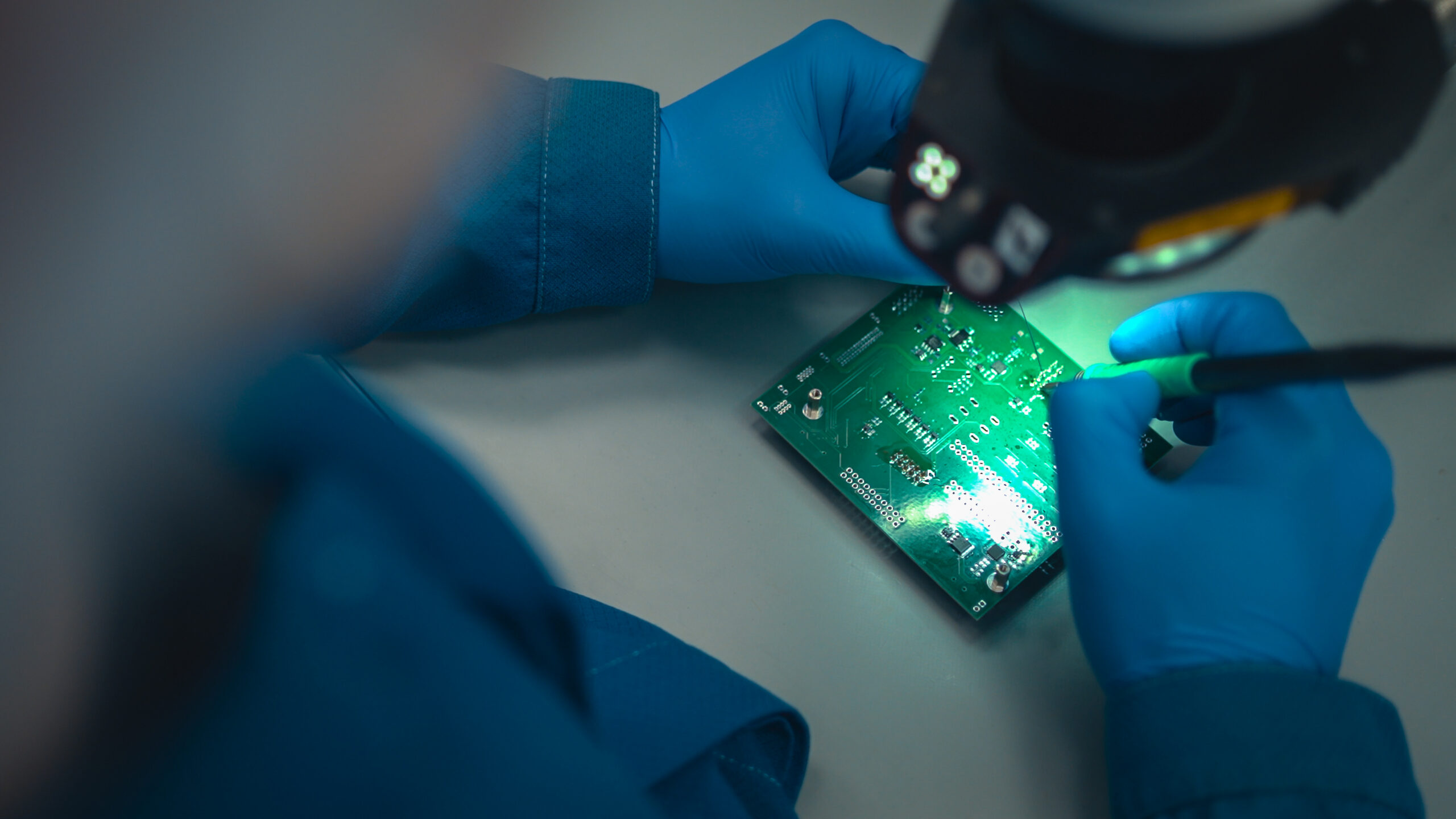
Hirel Manufacturing Capability Demonstration is performed in cooperation with G.L. Electronic, a Czech company with over 12 years of experience in electronics manufacturing for the aerospace industry. This ESA funded process development project in partnership with BD Sensors for outsourced PCB assembly to demonstrate compliance with ECSS-Q-ST-70-08/28/38.
HiRel is being carried out with funding from the European Space Agency under ESA Contract No. ESA AO 1-8859/16/NL/Cbi.
The project was closed in August 2023
HERMES
HERMES SP is a mission concept based on a constellation of nano-satellites in LEO, hosting new detectors to probe the X-ray temporal emission of bright high-energy transients. C3S supports the H2020 founded project amongst other tasks with preliminary trade-off’s and with own Ground Station design to demonstrate the communication. Expected close-out is in 2022 TRL9.
S3S
Development of multipurpose, thermally optimized satellite structure product line
In the course of this project – considering long-term goals as well – the main aim was to develop such mechanical architectures for cubesats, that facilitates the easier and shorter-term assembly of high quality, mission-oriented small satellites, when compared to our competitors.
As a result, our team developed 3, 6 and 12U structures, complying with cubesat standards, providing the optimal framework for small satellites.
RDSP – Radiation hardened digital space technology
The scope of this project was the research & development of a small-sized, compact, radiation hardened space technology that offers easy customization and fast manufacturability, along with low power consumption.
The project was a success. At its closure, our team developed the prototype of a complex, high reliability, radiation hardened power supply system, suitable for small satellites.
SatCOMM – S-band satellite communication module
In the course of this project C3S aims to develop a new technology-based, small satellite communication system, that offers a solution for one of the present-day problems of the evolution of the small satellite world.
The SatCOMM module will be able to replace the amateur, mostly “home-made” communication systems assembled during the construction of small satellites, in a way that it will be able to serve professional, civilian and industrial needs.
AI ON BOARD
Development of high-performance artificial intelligence boosting on-board computer hardware for small and large satellites
The mission is a collaborative project between C3S, a high reliable nanosat developer company and AIMotive a leading provider of camera-first, AI powered, Level 5 autonomous driving technology. The results of this collaboration are expected to accelerate the commercialization of a wide range of services for both specialized and mass-market applications, such as IoT, telecommunications, Earth and space observation, autonomous satellite operation, docking support, asteroid mining etc.

Establishing and expanding new design, manufacturing and integration capacity
In many areas of the aerospace and space industry, small series production and assembly are required in addition to prototype production processes. C3S had to outsource most part of these tasks, mainly to foreign partners, since such production capacity did not exist in Hungary until now.
This is one of the reasons why the company plans to build new capacity and expand the old one. Within the framework of this project, C3S also intends to expand the instrument park, which will enable multiple and parallel testing of high-reliability and safety-critical systems.
Development of manufacturing capacity at C3S
The aim of the development is to support C3S in balancing all the negative economical effects that Brexit caused. The capacity enhancment will positively effect the number of deliverable satellites per year.